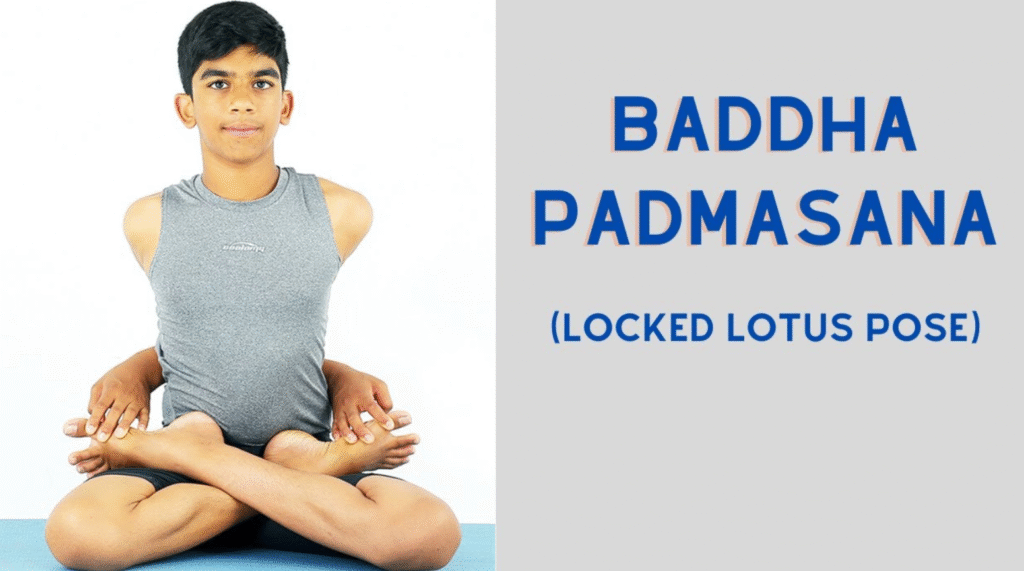
BADDHAPADMASANA
What Is Baddha Padmasana?
Baddha Padmasana is an advanced seated yoga pose in which the legs are crossed in a full lotus while the arms wrap around the back, catching the opposite toes. The spine remains erect, the shoulders open, and the chest expands naturally. Its purpose is to create a state of intense stability that facilitates uninterrupted meditation and pranayama.
It is considered a crown posture because it demonstrates complete opening of the hips, shoulders, and chest along with mental steadiness. The pose is revered for its ability to harmonize the mind, calm the nervous system, and support the awakening of the Kundalini energy.
Meaning and Symbolism of Baddha Padmasana
The symbolism of Baddha Padmasana ad is deeply spiritual:
Lotus represents purity, enlightenment, and transcendence
The bind symbolizes complete control over the senses
The lifted spine represents spiritual ascent
The cross-limb structure symbolizes unity of dualities—Shiva and Shakti
The meditative gaze represents inner focus
In yogic traditions, achieving a full lotus bind is seen as a metaphor for transcending physical limitations through discipline and practice Historical and Scriptural Roots
Origins in Ancient Yoga Texts
Baddha Padmasana appears in multiple classical texts:
Hatha Yoga Pradipika
Describes Padmasana and its variations as tools for controlling breath and awakening spiritual energy.
Gheranda Samhita
Includes Baddha Padmasana as a posture that enhances concentration and removes toxins from the system.
Yoga Korunta (Ashtanga lineage)
Defines the pose as a key asana in the advanced series.
These scriptures emphasize the pose not just for physical comfort but as a gateway to dhyana (meditation) and samadhi (absorption).
Significance inBaddha padmasana Traditional Practices
Historically, advanced yogis used Baddha Padmasana during:
Long meditation hours
Deep pranayama sessions
Mudra practices like Yoga Mudra
Introductory practices before Samadhi attempts
It was considered a posture for experienced practitioners due to the immense flexibility and stability required.
Anatomy and Biomechanics of Baddha Padmasana
This pose integrates multiple joints, especially:
Hip joints (external rotation, flexion)
Knees (flexion and rotational pressure)
Ankles (dorsiflexion)
Shoulders (extension + internal rotation)
Wrists and elbows
Because of this complexity, the posture must be approached with caution.
Key Muscle Groups Activated
Primary Muscles
Gluteus maximus, medius, minimus
Iliopsoas
Quadriceps
Hamstrings
Gastrocnemius
Soleus
Latissimus dorsi
Deltoids
Trapezius
Obliques
Erector spinae
Secondary Muscles
Rhomboids
Serratus anterior
Pectoralis minor
Arm muscles for the bind
The pose ensures that both the lower and upper body receive balanced engagement.
Preparing the Body for Baddha Padmasana
Because it is an advanced posture, preparation is essential.
Warm-Up Requirements
Hip Openers
Butterfly pose
Pigeon pose
Frog pose
Lizard pose
Shoulder Opening
Cow face pose arms
Shoulder rotations
Thread the needle
Spinal Warm-Up
Cat-cow
Seated forward folds
Gentle twists
Knee Conditioning
Half lotus practice
Supported lotus with props
Practicing these consistently helps unlock flexibility.
Step-by-Step Guide to Performing Baddha Padmasana
Step 1: Sit in Dandasana
Keep the spine erect, legs extended.
Step 2: Bring One Leg into Lotus
Place the right foot over the left thigh.
Step 3: Fold the Second Leg
Lift the left foot and place it over the right thigh.
Step 4: Bind the Hands Behind
Wrap both arms from behind the back and catch the big toes.
Step 5: Align the Spine
Ensure the back remains upright, chest open.
Step 6: Hold and Breathe
Close your eyes and maintain slow, steady breaths.
Duration, Breathing, and Drishti
6.1 How Long to Hold?
1–3 minutes for beginners,
5–15 minutes for advanced practitioners.
6.2 Breathing Pattern
Use diaphragmatic breathing or Ujjayi breathing.
6.3 Drishti (Gaze Point)
Nasagra drishti (nose tip)
Ajna chakra center
Benefits of Baddha Padmasana (Complete List)
7.1 Physical Benefits
Improves hip flexibility
Strengthens legs
Enhances digestion
Reduces menstrual cramps
Opens chest and shoulders
Improves posture
Strengthens spine
Improves circulation
7.2 Mental Benefits
Reduces anxiety
Enhances concentration
Promotes mental stability
Improves emotional balance
Supports meditation
Spiritual Benefits
Activates Muladhara, Manipura, and Anahata chakras
Enhances energy flow
Encourages inner awakening
Supports pranayama
Deepens meditation
Variations of Baddha Padmasana
1. Ardha Baddha Padmasana
Half-bound version.
2. Yoga Mudra in Baddha Padmasana
Forward fold while bound.
3. Baddha Padma Shiva Mudra
With mudras for energy awakening.
4. Vajra Baddha Padmasana
Performed on heels.
Common Mistakes to Avoid
Forcing knees into lotus
Bending spine forward
Incorrect shoulder bind
Holding breath
Practicing without warm-up
Contraindications
Avoid if you have:
Knee injuries
Hip issues
Sciatica
Weak ankles
Severe lower-back problems
Therapeutic Applications
Baddha Padmasana helps with:
Anxiety disorders
Digestion issues
Stress management
Fatigue
Muscular stiffness
- Respiratory health
The Science Behind Baddha Padmasana
Nervous System Effect
Stimulates parasympathetic system → relaxation response.
Hormonal Balance
Enhances endocrine functioning.
12.3 Blood Circulation
Improves flow towards the trunk and brain.
Baddha Padmasana for Meditation
This posture stabilizes the body to help enter:
Dharana
Dhyana
Samadhi
The bound structure prevents unconscious movement.
Baddha Padmasana in Modern Yoga
Used in:
Ashtanga Yoga
Hatha Yoga
Iyengar Yoga
Kundalini Yoga
Himalayan Yoga traditions
Tips for Mastery
Practice daily hip openers
Strengthen core
Improve spinal flexibility
Do not rush the lotus
Listen to your body
Plan to Achieve Baddha Padmasana
Week 1: Hip openers + half lotus
Week 2: Deep hip mobility + shoulder work
Week 3: Practice lotus daily + mild binds
Week 4: Full lotus + bind attempts
Myths and Truths
Myth: Only flexible people can do this.
Truth: Flexibility can always be improved.
Myth: Knees support the stretch.
Truth: Hips do—knees must stay safe.
Conclusion
Baddha Padmasana is a treasured pose in yoga tradition—a symbol of spiritual readiness, physical mastery, and deep mental stillness. While it requires patience, discipline, and practice, the journey toward this pose itself becomes a profound experience of self-discovery. Whether you are working toward it or already practicing it, this asana can transform your physical, mental, and spiritual well-being when approached safely and mindfully.